
Train with evidence

Weekly sets per muscle, RIR and mesocycles, the way the research says. No ads.

Notify me at launch

Coming soon to Google Play

Free, no ads and no account needed. We'll email you the day it's out.

10–20
hard sets per muscle per week
RIR
on every set
0
ads
Ferro's Stats screen: this week's muscle split, with each muscle's sets against its 10 to 20 range.

Hard sets this week

Chest14 of 10–20 · in range
Back17 of 10–20 · in range
Side delts8 of 10–20 · 2 to go

What Ferro does

A gym log that measures what drives growth and tells you what to do today.

Weekly sets per muscle

See how many hard sets each muscle has this week and how many it still needs to reach its range.
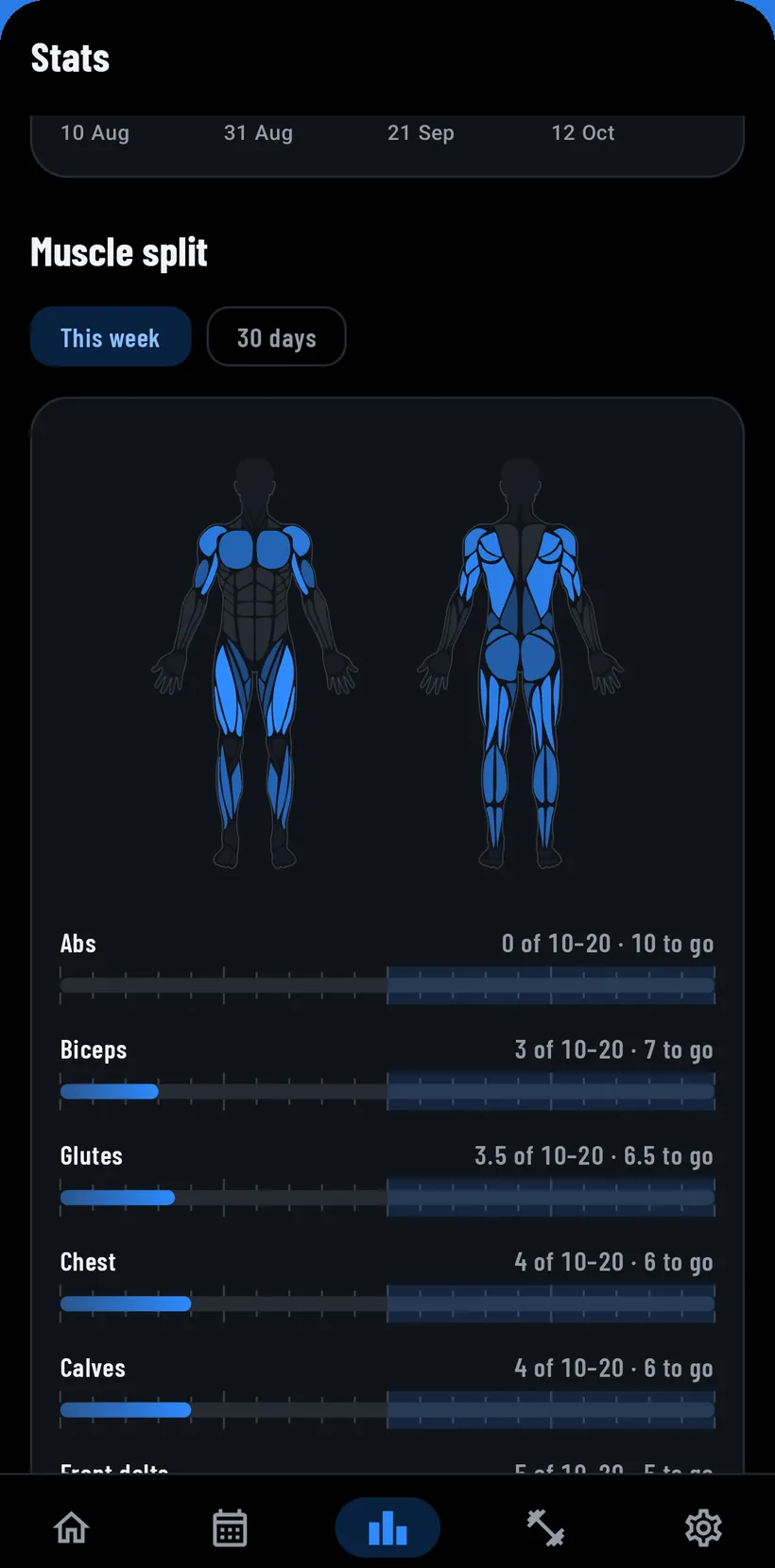
This week's muscle split: abs, biceps, glutes and chest, each with its scale and how many sets it needs to reach 10.

Every set, with its RIR

Log your reps in reserve; progression decides whether to add weight or repeat it.
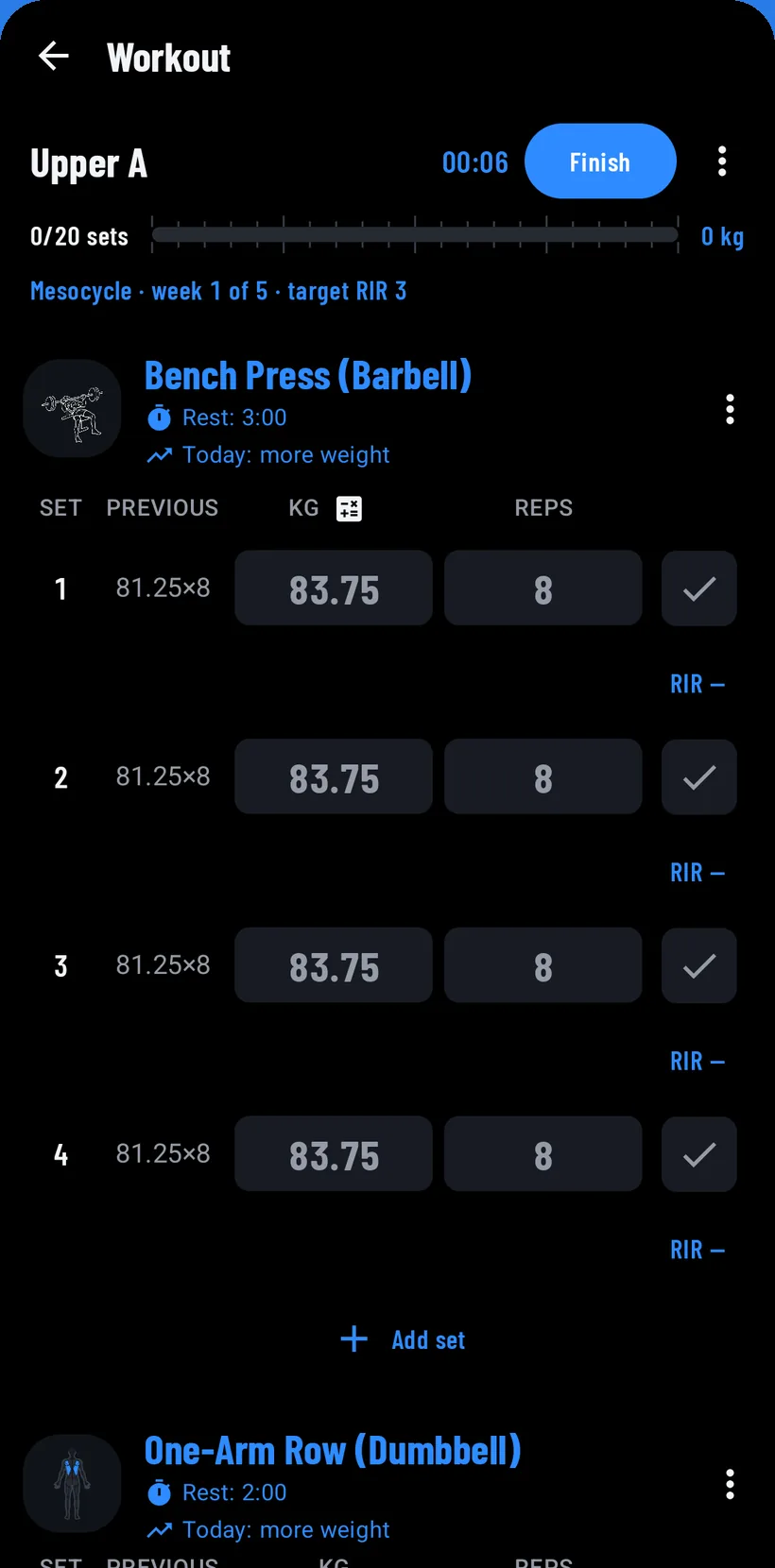
Upper A workout in progress: bench press with four sets of 83.75 kg for 8, the RIR for each set and the hint “Today: add weight”.

Mesocycles backed by evidence

Blocks of 3 to 5 weeks that move closer to failure and end in a deload, each with its studies.
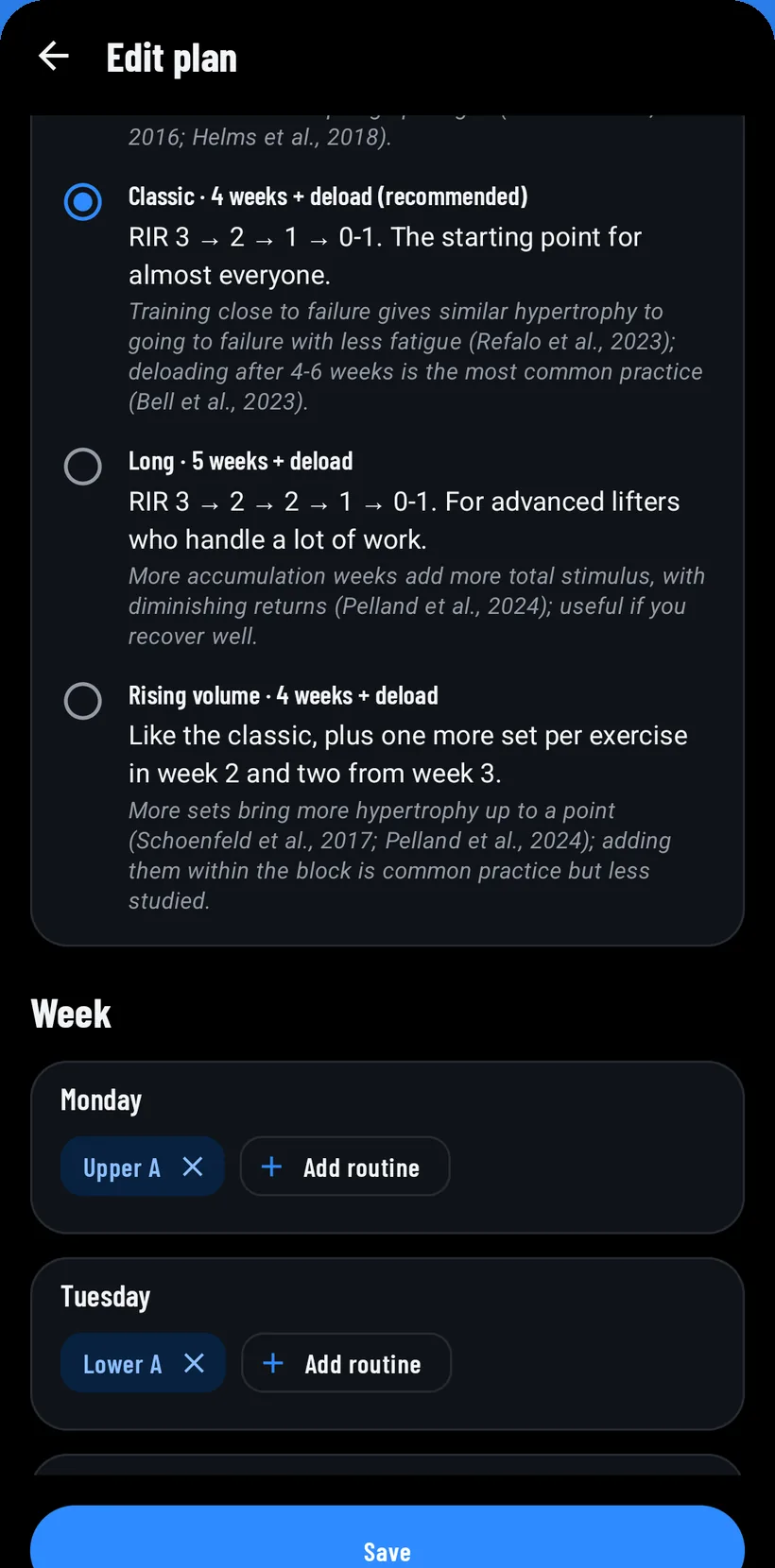
Choosing a mesocycle: short, classic, long and rising volume, with each week's RIR and the studies behind each one.

A program that fits your week

Pick 3 to 6 days; the Ferro Program builds the split with all of the above.
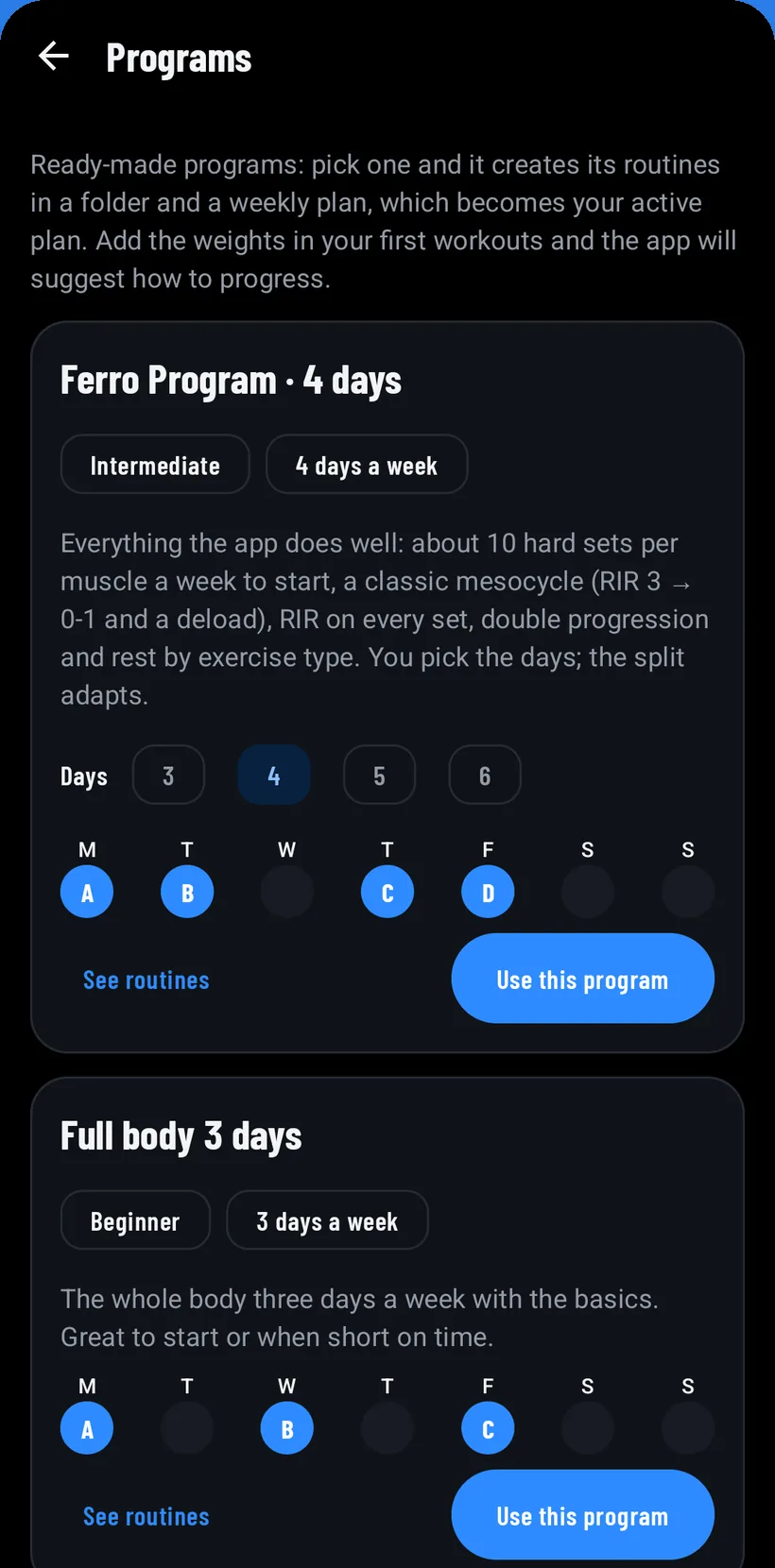
4-day Ferro Program: what it includes, the 3 to 6 day picker and routines A, B, C and D laid out across the week.

Based on studies

These are the studies behind Ferro's numbers: the set range, how secondary muscles count, RIR and deloads. They aren't everything published on each topic, and none of them is the final word. That's why we also tell you their limits.

Weekly volume

More weekly sets bring more hypertrophy, up to a point.

Schoenfeld et al. 2017Pelland et al. 2024

Studies and limits

Schoenfeld, Ogborn and Krieger (2017)

Dose-response relationship between weekly resistance training volume and increases in muscle mass: A systematic review and meta-analysis. Journal of Sports Sciences, 35(11), 1073–1082. doi:10.1080/02640414.2016.1210197

What it found
A meta-analysis of 15 studies. Each additional weekly set was associated with a little more muscle growth: a graded dose-response relationship. Groups doing 10 or more sets per muscle per week tended to grow more than those doing fewer.
Limits
Few studies, and the comparison by bands (under 5, 5 to 9 and 10 or more sets) only showed a trend, not a significant difference.

Pelland, Remmert, Robinson, Hinson and Zourdos (2026)

The Resistance Training Dose Response: Meta-Regressions Exploring the Effects of Weekly Volume and Frequency on Muscle Hypertrophy and Strength Gains. Sports Medicine, 56(2), 481–505. doi:10.1007/s40279-025-02344-w. First released as a SportRxiv preprint (2024), doi:10.51224/srxiv.460, which is why the app cites it as Pelland et al. 2024.

What it found
A meta-analysis of 67 studies and 2,058 participants. More weekly sets meant more muscle and more strength, but with diminishing returns. Counting each indirect set as half a set was the counting method that best fitted the hypertrophy data. Training a muscle on more days per week, with the same sets, made little difference to hypertrophy.
Limits
79% of participants were men, with an average age of 25.

In Ferro

  • The default range: 10 to 20 hard sets per muscle per week. Going over 20 shows as "above range", not as a mistake, because it still adds up, just less and less.
  • Secondary muscles count as half a set by default.
  • The long and rising-volume mesocycles.

Proximity to failure

Stopping close to failure gives similar hypertrophy to reaching it.

Refalo et al. 2023

Studies and limits

Refalo, Helms, Trexler, Hamilton and Fyfe (2023)

Influence of Resistance Training Proximity-to-Failure on Skeletal Muscle Hypertrophy: A Systematic Review with Meta-analysis. Sports Medicine, 53(3), 649–665. doi:10.1007/s40279-022-01784-y

What it found
A meta-analysis of 15 studies. Going to failure gave no more hypertrophy than stopping close to it, and getting closer to failure didn't always mean more growth. The authors point to a non-linear relationship and suggest ending most sets close to failure to limit accumulated fatigue.
Limits
Each study defines "failure" its own way, which makes them hard to compare.

In Ferro

  • Only hard sets count: 4 reps or fewer from failure.
  • If you hit failure, progression suggests repeating the weight instead of adding more.
  • The classic mesocycle gets closer to failure week by week: RIR 3, 2, 1 and 0-1.

RIR and RPE

Reps in reserve as a measure of how hard each set is.

Helms et al. 2018Zourdos et al. 2016

Studies and limits

Zourdos, Klemp, Dolan et al. (2016)

Novel Resistance Training–Specific Rating of Perceived Exertion Scale Measuring Repetitions in Reserve. Journal of Strength and Conditioning Research, 30(1), 267–275. doi:10.1519/JSC.0000000000001049

What it found
29 people squatted at different percentages of their max and rated effort as reps in reserve (RPE 10 = none in reserve, RPE 9 = one…). The slower the rep, the higher the RPE, in both experienced lifters and novices. The authors conclude it is a practical way to regulate each day's load.
Limits
A single exercise and a small sample.

Helms, Byrnes, Cooke et al. (2018)

RPE vs. Percentage 1RM Loading in Periodized Programs Matched for Sets and Repetitions. Frontiers in Physiology, 9, 247. doi:10.3389/fphys.2018.00247

What it found
21 trained men, 8 weeks of squat and bench press with the same sets and reps. Choosing the weight by RPE worked as well as choosing it by percentage of max, with a possible small strength advantage for RPE.
Limits
A small sample, only men aged 19 to 35.

In Ferro

  • Every set is logged with its RIR: 0 at failure, 1, 2, 3, 4, or 5 or more.
  • Progression adds weight when you reach the top of the rep range with reps to spare.
  • Each mesocycle week has a target RIR, and the short mesocycle is based on these two studies.

Deloads

A deload every 4 to 6 weeks is the most common practice.

Bell et al. 2023

Studies and limits

Bell, Strafford, Coleman, Androulakis Korakakis and Nolan (2023)

Integrating Deloading into Strength and Physique Sports Training Programmes: An International Delphi Consensus Approach. Sports Medicine – Open, 9, 87. doi:10.1186/s40798-023-00633-0

What it found
A consensus of expert strength and physique coaches, over three rounds. They define a deload as a period of reduced training stress to lower fatigue, recover and be better prepared for the next block, and agree it can be done by cutting sets, reps or training days. They note deloads are usually done every 4 to 6 weeks and last about 7 days.
Limits
It is expert opinion, not a trial comparing outcomes.

In Ferro

  • Every mesocycle ends with a deload week: half the sets, same weight.

Spotted a mistake in a citation or in how we describe it? Write to us at hola@getferro.app.

Your data is yours

  • No ads

    No ads and no analytics.

  • No account, no connection

    Everything is stored on your phone and works in a gym with no signal.

  • Optional account

    With Google or email: cloud backup and sync across your devices.

  • Bring your history

    Coming from Strong or Hevy? Import your whole history in a minute.

FAQ

What people ask most before installing Ferro.

Do I need an account?

No. Without an account, everything is stored on your phone.

The account is optional, with Google or email. It keeps a copy of your data in the cloud and in sync across your devices.

Does it work offline?

Yes. Everything works without internet, even in a gym with no signal. Only the cloud backup needs a connection.

Can I bring my history from Strong or Hevy?

Yes. Export your history as CSV from Strong or Hevy, then in Ferro go to Settings → Import from Strong or Hevy and pick the file.

What is a hard set?

A completed set, not a warm-up, where you stopped 4 reps or fewer from failure (RIR 4 or less). If you don't log RIR, it counts as hard.

These are the sets that count towards each muscle's weekly target. Stopping close to failure gives similar growth to reaching it (Refalo et al., 2023), so there's no need to grind out every set.

How do secondary muscles count?

Every set counts as one for the target muscle and as a fraction for the secondary ones, depending on the exercise:

  • half a set by default, the counting method that best predicts hypertrophy (Pelland et al., 2024);
  • a quarter if the muscle does little;
  • nothing if it barely works.

For example, the bench press counts half a set for triceps, and squats count nothing for hamstrings.

How many sets should I do?

By default, 10 to 20 hard sets per muscle per week (Schoenfeld et al., 2017; Pelland et al., 2024). You can change each muscle's range in Stats → Muscle split → Adjust ranges.

What happens to my data if I uninstall the app?

Without an account, it goes with the app, unless you export a backup from Settings first. With an account, it comes back when you sign in.

To delete the cloud copy too, see how to delete your account.

Is there an iPhone version?

No. For now Ferro is Android only.

How much does it cost?

Nothing. Ferro is free and has no ads.

Something else? Write to us at hola@getferro.app.

Your week, in range

Ferro is coming soon to Google Play. Send us your email and we'll let you know the day it's out.